SciTalk: Investigating the Effects of Testosterone on the Human Immune System
Camila Consiglio is a recipient of the Michelson Prizes: Next Generation Grants
Camila Consiglio, Ph.D. Marie Skłodowska-Curie Postdoctoral Fellow, Women's and children's health, Karolinska Institutet

Why Your Biological Sex Might Be the Most Important Factor in How You Fight Disease
The Curious Case of the "Man Flu" and Beyond
The term "man flu" is often dismissed as a cultural trope, a shorthand for the perceived exaggeration of symptoms in men. However, from the perspective of a biomedical strategist, this observation hints at a profound biological reality: the immune system is not a universal constant. The COVID-19 pandemic provided a stark, global validation of this heterogeneity. While some patients infected with SARS-CoV-2 remained entirely asymptomatic, others faced fatal respiratory failure. This staggering range of clinical outcomes underscores a critical gap in our understanding of human immunity.Dr. Camila Consiglio, a postdoctoral researcher at the Karolinska Institute and recipient of the 2021 Michelson Prize, is spearheading research to decode these discrepancies. Her work identifies testosterone as a primary lever in human immunity—a biological "dial" that fundamentally recalibrates how the body responds to pathogens.
The Clinical Data: Mapping the Sex-Based Immune Gap
For decades, medicine has largely operated under a "one-size-fits-all" model, often ignoring the systemic immune variations between biological sexes. However, clinical data reveals a consistent "disease divide" that demands a more nuanced approach to drug development and public health strategy:- Male Susceptibility: Biological males consistently face higher severity rates across a spectrum of infections, including viral (such as SARS-CoV-2), bacterial, fungal, and parasitic diseases.
- Oncology Disparities: Males develop cancer at significantly higher rates than females.
- The Female Immune Edge: Biological females typically mount a more robust response to vaccinations, often producing more potent protective markers.
The Double-Edged Sword of Female Immunity
The heightened immune vigor seen in females is a double-edged sword. Research indicates that females can produce twice as many antibodies to certain vaccines compared to males. While this provides superior protection against many pathogens, it comes at a steep biological cost.This high-performance state is linked to significantly higher rates of vaccine-induced side effects and a disproportionate prevalence of autoimmune disorders. As Dr. Consiglio explains, the strategic objective is to "understand how biological sex impacts the immune function [to] better understand how diseases are developing differently between males and females and also optimize strategies to treat these infectious diseases." By deciphering the mechanics of this trade-off, we can begin to balance the scales of immune protection.
The Genetic vs. Hormonal Riddle
Immunologists have identified three primary drivers of sex-based immune differences: societal factors, genetics (the XX vs. XY chromosomal blueprint), and sex hormones.The Challenge: Decoupling Confounded Variables Historically, it has been nearly impossible to isolate the specific impact of chromosomes from that of hormones. In nature, these variables are almost always "confounded"—meaning an XX genetic background typically co-occurs with a female hormonal profile. This entanglement has remained a major hurdle in biomedical research, preventing scientists from determining whether an immune response is hardwired in the DNA or modulated by the endocrine system.
The "Natural Experiment": A Systems-Level Breakthrough
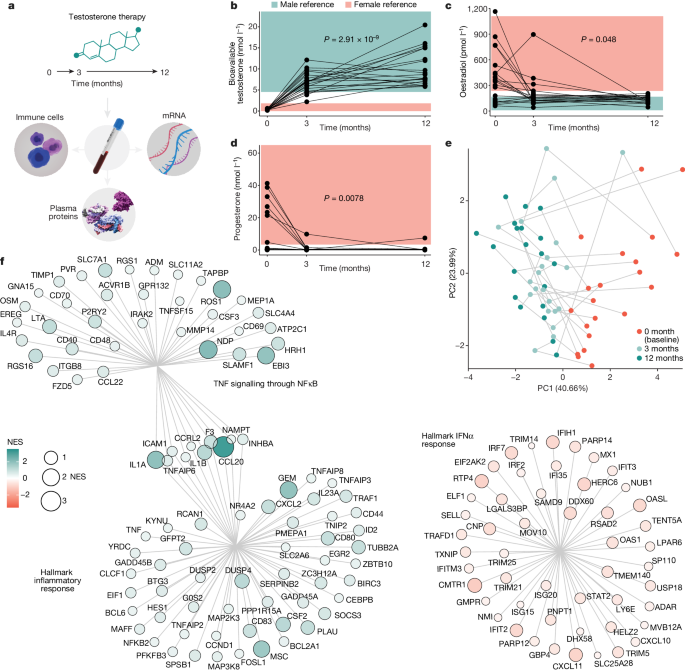
To solve this riddle, Dr. Consiglio and the Broden Lab at the Karolinska Institute utilized a brilliant research design: a cohort of individuals undergoing female-to-male (FtM) transition. This provides a "natural experiment" where the genetic background remains fixed (XX chromosomes) while the hormonal environment is systematically transitioned via testosterone treatment.This research moves beyond traditional "low-throughput" immunology, which often studies a single cell type or protein in isolation. Instead, the team employs a systems-level approach, utilizing advanced computational methods and AI to integrate multiple data layers simultaneously. This allows researchers to observe the complex interplay between:
- The Plasma Proteome: The vast array of signaling proteins in the blood.
- Immune Cell Phenotype: The shifting composition and functional states of immune cells.
- The Transcriptome: The complete set of RNA transcripts indicating which genes are actively being expressed.
The Future of "Sex-Fitting" Vaccines
This research signals a paradigm shift in how we approach drug development and clinical trial design. For too long, medicine has ignored the reality that biological sex dictates how a body processes a vaccine or fights a virus. By understanding how testosterone modulates antiviral responses, we can move toward a model of "sex-informed immunology."This is not merely an academic exercise; it is a strategic necessity for future pandemic preparedness. The goal is to design "optimal vaccine strategies that can fit one's biological sex," potentially involving sex-specific dosages or delivery mechanisms. By moving away from the "one-size-fits-all" failure, we can maximize efficacy and minimize adverse reactions across the entire population.
Conclusion: Redefining Human Variation
The work being conducted at the Karolinska Institute is providing the blueprint for a new era of medicine. Systems-level immunomonitoring, powered by computational analysis, is finally allowing us to speak the "immune language" of hormones.As we move toward this high-resolution understanding of human health, we must redefine our approach to patient care. We are no longer looking at a singular human immune system, but a dynamic, hormone-regulated architecture. The question for the next generation of medicine is no longer if sex matters, but how quickly we can integrate these "sex-fitting" insights to prevent the next global health crisis.
Last edited by a moderator: