Multicenter Analysis of Standard of Care versus Oxandrolone versusTestosterone in burn hypermetaboliSm (MASCOTS): First Interim Analysis

madman

Super Moderator

1789218663976.webp

1789218799851.webp

1789218816177.webp

1789218836184.webp
 

Attachments

 
Dear Dr Hong

Thanks for presenting the initial data on oxandrolone, testosterone, and SOC in burned patients. One of my forum moderators posted information and a video of a short presentation you gave: Multicenter Analysis of Standard of Care versus Oxandrolone versusTestosterone in burn hypermetaboliSm (MASCOTS): First Interim Analysis

Several years ago, I coauthored a book on HIV wasting called "Built to Survive" and authored a small pilot study using oxandrolone in women experiencing HIV-related wasting. https://www.academia.edu/87267156/Oxandrolone_Anabolic_steroid_use_in_HIV_positive_women


I just wanted to let you know that oxandrolone is currently available via compounding.

Oxandrolone Tablets

I was surprised to see that patients on oxandrolone or testosterone gained less weight than those on SOC. I am curious to know your thoughts on that finding.

Thanks again for your research.

All the best,

Nelson Vergel
 

MASCOTS Interim Data: Testosterone as an Oxandrolone Substitute in Burn Care​


Burn units lost oxandrolone in June 2023, when the FDA withdrew market approval for Oxandrin and its generics. Since then, physicians have used testosterone as a substitute anabolic agent in severely burned patients, largely without comparative data. A new multicenter analysis called MASCOTS gives the first head-to-head look at outcomes. [00:00]

Study design​


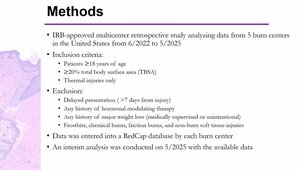
Researchers at LSU Health Sciences Center in New Orleans ran a retrospective analysis across 5 US burn centers. The analysis covers adults with burns over 20% of total body surface area (TBSA), treated from June 2022 to May 2025, across three groups:

  • Oxandrolone
  • Testosterone
  • Standard of care, no anabolic agent

The interim analysis includes 200 patients: 61 on oxandrolone, 7 on testosterone, 132 on standard of care. Exclusions: prior hormone-modulating therapy, major pre-injury weight loss, non-thermal burns.

Key findings [04:18]​


OutcomeOxandroloneTestosteroneStandard of Care
Length of stayLongerLongestShortest
Graft loss (reoperation)LowerLowerHighest
Weight loss, admission to dischargeModerateHighestLowest

The only statistically significant difference was percent weight change. Testosterone patients lost the most weight in hospital. The standard-of-care group lost the least. This held up when the researchers grouped all steroid use together against no steroid at all.

Length of stay and graft loss trends did not reach statistical significance. The authors point to the small testosterone group (n=7) as a likely factor. Patients on any anabolic agent also received more propranolol. This suggests a higher hypermetabolic burden in these groups, which limits direct comparison.

Paraphrased from Aaron Hong said:
The interim data do not show a weight-preservation advantage for testosterone over other approaches. A final analysis is expected in December 2026, with more than 600 patients across 11 burn centers.

A second data point: oxandrolone vs somatropin/testosterone [11:03]​


A separate single-center study compared oxandrolone against a combined somatropin (growth hormone) and testosterone approach. It found no significant differences in length of stay, weight change, nitrogen balance, mortality, wound closure, graft failure, or infection rate.

The groups did differ on safety. About 20% of oxandrolone patients needed a dose adjustment for elevated liver enzymes, versus 12.5% in the somatropin/testosterone group. No hyperglycemia events requiring treatment changes were reported with somatropin in this cohort.

Presenter name : A. Hong

Why this matters for ExcelMale members​


  • This reflects acute burn ICU care. It doesn't map onto outpatient TRT dosing or expected outcomes.
  • The liver enzyme signal with oxandrolone tracks with what many TRT patients already know from oral 17-alpha-alkylated steroids: LFTs need monitoring on these compounds regardless of clinical setting.
  • This shows how physicians repurpose androgen therapy when a preferred agent disappears from the market.

Bottom line​


The first MASCOTS interim data don't support testosterone as a weight-preserving substitute for oxandrolone. The small testosterone sample (n=7) limits how much weight that finding can carry. A separate comparison of oxandrolone against somatropin/testosterone found comparable outcomes overall, aside from oxandrolone's higher rate of liver-enzyme-related dose adjustments. Final MASCOTS data are expected in December 2026.

Source: Aaron Hong, MD, et al., "Multicenter Analysis of Standard of Care versus Oxandrolone versus Testosterone in Burn Hypermetabolism (MASCOTS): First Interim Analysis," LSU Health Sciences Center, Department of Surgery.
Multicenter Analysis of Standard of Care versus Oxandrolone versus Testosterone in burn hypermetaboliSm (MASCOTS)

Tags: #TRT #Testosterone #Oxandrolone #BurnCare #Hypermetabolism #Anabolic #HormoneOptimization
 
Why Did Adding Oxandrolone to Burn Care Fail to Improve Weight Gain?

Yes. The available data provide a fairly coherent explanation, and the negative "weight gain" finding does not appear to mean oxandrolone had no anabolic activity.

There are two studies worth separating first.

The July 28, 2026 MASCOTS study enrolled 813 adult burn patients across 12 US centers. It compared oxandrolone, testosterone, HGH, or no anabolic supplementation. Anabolic treatment did not significantly improve inpatient weight maintenance versus standard care, P = .064.

This study did not specifically test oxandrolone added to propranolol.

https://pubmed.ncbi.nlm.nih.gov/42518198/']MASCOTS study, PubMed[/URL]

The study that directly tested oxandrolone plus propranolol against standard care was the pediatric Chao trial. It found no greater change in total body weight or lean body mass with the combination, even though muscle strength, power, protein synthesis, and net muscle protein balance improved.

https://pmc.ncbi.nlm.nih.gov/articles/PMC5820183/']Oxandrolone plus propranolol trial[/URL]

That distinction is important.

1. Propranolol itself is already a strong anabolic intervention in severe burns

This might be the most important explanation.

The classic propranolol burn study found:


  • []Propranolol increased net muscle protein balance by 82 percent.
    [
    ]Controls experienced a 27 percent deterioration.
    []Fat-free mass was essentially preserved with propranolol.
    [
    ]Controls lost about 9 percent of fat-free mass.

The mechanism was particularly interesting.

Propranolol did not primarily stop proteolysis. Instead, beta blockade increased muscle protein synthesis and intracellular recycling of amino acids.

https://www.nejm.org/doi/full/10.1056/NEJMoa010342']Propranolol and muscle protein metabolism in severe burns, NEJM[/URL]

Oxandrolone appears to act through a surprisingly similar downstream metabolic endpoint.

In burned children, oxandrolone increased muscle protein synthesis efficiency and improved net protein balance without significantly reducing protein breakdown.

Intracellular amino acids released from protein turnover were redirected toward protein synthesis rather than leaving the muscle cell.

https://pmc.ncbi.nlm.nih.gov/articles/PMC1514675/']Oxandrolone and muscle protein metabolism[/URL]

A simplified model looks like this:

Severe burn

→ catecholamine excess

→ increased resting energy expenditure

→ increased substrate cycling

→ muscle amino-acid loss

→ negative protein balance

Propranolol:

Lower adrenergic drive

→ lower energy expenditure

→ greater protein synthetic efficiency

→ greater intracellular amino-acid recycling

→ improved net protein balance

Oxandrolone:

Androgen receptor signaling

→ greater protein synthetic efficiency

→ greater intracellular amino-acid recycling

→ improved net protein balance

These drugs act through different upstream mechanisms, yet both ultimately improve muscle protein economy.

This raises the possibility of an anabolic ceiling.

2. Evidence for an anabolic ceiling already exists

Researchers tested growth hormone, propranolol, growth hormone plus propranolol, and standard care in severely burned children.

Propranolol improved muscle protein balance.

Adding growth hormone to propranolol produced essentially the same response.

Growth hormone did not provide a meaningful additional anabolic effect.

The researchers proposed a ceiling of anabolic effect, where propranolol had already shifted muscle protein metabolism far enough toward anabolism that another anabolic intervention had limited room to improve the measured endpoint.

https://pmc.ncbi.nlm.nih.gov/articles/PMC1422599/']Growth hormone plus propranolol burn study[/URL]

This phenomenon fits the oxandrolone plus propranolol findings surprisingly well.

3. Body weight is a poor endpoint in acute burn research

Burn researchers have repeatedly warned about relying on body weight.

Initial burn resuscitation often adds enormous amounts of fluid.

Subsequent diuresis is unpredictable.

Weight is influenced by:


  • []IV fluid resuscitation
    [
    ]Edema
    []Hypoalbuminemia
    [
    ]Renal function
    []Ventilation
    [
    ]Infection
    []Repeated grafting and surgery
    [
    ]Inflammation
  • Changes in extracellular water

These variables move scale weight independently of skeletal muscle.

https://pmc.ncbi.nlm.nih.gov/articles/PMC5393025/']Nutrition and metabolic management of burn patients[/URL]

A contemporary burn cohort found that patients with burns greater than 20 percent total body surface area often gained roughly 5 to 8 percent above baseline weight during the first week because of resuscitation fluid.

https://pmc.ncbi.nlm.nih.gov/articles/PMC6192117/']Weight change following major burns[/URL]

A later study even developed an edema-adjusted "dry weight" equation because hospital scale weights poorly represented actual tissue loss.

https://pubmed.ncbi.nlm.nih.gov/36764841/']Edema-adjusted body weight after burn injury[/URL]

Consider this simple example:

2 kg additional muscle retention

5 kg fluid loss

=

3 kg reduction on the scale

The reverse also happens:

No change in muscle

4 kg retained fluid

=

4 kg apparent weight gain

Therefore, total body weight is a weak marker of anabolic activity during acute burn recovery.

DEXA, muscle protein tracer studies, muscle strength, nitrogen balance, CT muscle area, and longer-term functional outcomes provide more useful information.

4. The OxProp trial itself demonstrates the disconnect

In the Chao trial:

Body weight

Control:
38.4 → 40.5 kg

Oxandrolone plus propranolol:
44.6 → 47.3 kg

Lean mass

Control:
26.6 → 28.4 kg

Oxandrolone plus propranolol:
30.0 → 31.9 kg

Both groups gained lean mass.

The magnitude of lean-mass change was statistically similar.

Yet muscle physiology told a different story.

Strength increase:

Control:
+14.4 N·m

OxProp:
+22.3 N·m

Power increase:

Control:
+16.7 W

OxProp:
+30.8 W

Muscle fractional synthetic rate was also significantly greater with OxProp after rehabilitation.

Net muscle protein balance was significantly better.

https://pmc.ncbi.nlm.nih.gov/articles/PMC5820183/']Full OxProp rehabilitation study[/URL]

This is strong evidence against interpreting "no additional weight gain" as "no anabolic effect."

5. The treatment window might have been too short

The Chao trial used only six weeks of rehabilitation relatively soon after the burn injury.

The investigators discussed this limitation.

Earlier studies showing larger oxandrolone-related increases in lean mass used approximately 12 weeks of exercise and studied patients later after injury.

In one earlier study:


  • []Exercise alone increased lean mass about 5.8 percent.
    [
    ]Oxandrolone alone increased lean mass about 5.4 percent.
  • Oxandrolone plus exercise increased lean mass about 13.1 percent.

In the shorter OxProp study:


  • []Control increased lean mass about 6.8 percent.
    [
    ]OxProp increased lean mass about 6.3 percent.

The researchers specifically suggested that the shorter six-week program and earlier post-burn timing contributed to the failure to separate lean-mass outcomes.

https://pmc.ncbi.nlm.nih.gov/articles/PMC5820183/']Chao et al. OxProp trial[/URL]

6. Oxandrolone's larger body-composition effects appear later

Long-term oxandrolone studies have found effects months after acute hospitalization.

One pediatric study found significant differences in weight, lean mass, and bone outcomes during prolonged follow-up.

Some improvements continued after oxandrolone was discontinued.

https://pmc.ncbi.nlm.nih.gov/articles/PMC1357746/']Long-term oxandrolone study[/URL]

A much larger study involving 612 severely burned children also found clinically meaningful long-term effects from combined propranolol and oxandrolone therapy.

OxProp shortened post-burn growth arrest by approximately 84 days.

Growth velocity increased by approximately 1.7 cm per year versus control.

https://pmc.ncbi.nlm.nih.gov/articles/PMC5167626/']Long-term OxProp outcomes[/URL]

These findings occurred after prolonged treatment.

An acute inpatient weight study therefore risks looking at the wrong endpoint during the wrong period.

7. Oxandrolone does not appear to interfere with propranolol pharmacokinetics

Researchers specifically examined this possibility.

Ninety-two severely burned pediatric patients received propranolol alone or oxandrolone plus propranolol.

Oxandrolone did not significantly alter:


  • []Propranolol plasma concentrations
    [
    ]Propranolol half-life
    []Maximum propranolol concentration
    [
    ]Minimum propranolol concentration
  • Heart-rate response

Therefore, failure to produce additional weight gain does not appear to result from oxandrolone reducing propranolol exposure.

https://pubmed.ncbi.nlm.nih.gov/28240622/']Oxandrolone and propranolol pharmacokinetics[/URL]

8. Modern standard burn care is much more anabolic than historical care

This matters when comparing older studies with newer studies.

Modern burn treatment includes:


  • []Earlier excision and grafting
    [
    ]High-protein enteral nutrition
    []Improved metabolic support
    [
    ]Earlier mobilization
    []Resistance rehabilitation
    [
    ]Better infection control
  • Improved fluid management

Contemporary patients often lose far less body weight than historical burn cohorts.

Patients with major burns now often lose less than 10 percent of baseline weight, compared with historical reports approaching 20 percent or more.

https://pmc.ncbi.nlm.nih.gov/articles/PMC6192117/']Modern burn weight-loss data[/URL]

This produces another ceiling effect.

If modern care already prevents much of the muscle and weight loss seen in older patients, the remaining difference available for an anabolic drug to demonstrate becomes much smaller.

9. The 2026 MASCOTS study has an important confounding issue

MASCOTS was not a randomized oxandrolone plus propranolol trial.

It was a multicenter observational analysis.

An earlier MASCOTS report showed:


  • []Oxandrolone median weight change: -4.0 kg
    [
    ]Testosterone: -2.4 kg
  • Standard care: -0.25 kg

Yet the patients receiving anabolic therapy also had substantially longer hospital stays.

Median length of stay:


  • []Oxandrolone: 36 days
    [
    ]Testosterone: 36 days
  • Standard care: 25 days

https://pmc.ncbi.nlm.nih.gov/articles/PMC13058052/']MASCOTS cohort report[/URL]

This raises a major possibility of confounding by indication.

Clinicians tend to prescribe anabolic therapy to patients who:


  • []Appear more catabolic
    [
    ]Have larger or deeper burns
    []Remain hospitalized longer
    [
    ]Have more nutritional difficulty
    []Have slower recovery
    [
    ]Are failing to maintain weight

Propensity matching helps reduce this problem, but unmeasured confounding still exists.

The final 813-patient study therefore does not prove that anabolic therapy caused worse weight outcomes.

It shows that anabolic supplementation failed to demonstrate an independent inpatient weight-maintenance advantage within this real-world cohort.

https://pubmed.ncbi.nlm.nih.gov/42518198/']Final 2026 MASCOTS study[/URL]

How I Interpret These Findings
 
Why Did Adding Oxandrolone to Burn Care Fail to Improve Weight Gain?

Propranolol, oxandrolone, anabolic ceilings, and the limitations of scale weight in severe burn recovery

Key point: Failure to increase short-term body weight does not mean oxandrolone lacked anabolic activity.
The strongest explanations are a ceiling effect from propranolol and modern burn care, distortion of body weight by fluid shifts, and a treatment window too short to capture longer-term changes in lean mass and function.
The available data provide a fairly coherent explanation, and the negative "weight gain" finding does not appear to mean oxandrolone had no anabolic activity.

There are two studies worth separating first.

The July 28, 2026 MASCOTS study enrolled 813 adult burn patients across 12 US centers. It compared oxandrolone, testosterone, HGH, or no anabolic supplementation. Anabolic treatment did not significantly improve inpatient weight maintenance versus standard care, P = .064.

This study did not specifically test oxandrolone added to propranolol.

Source: MASCOTS study, PubMed

The study that directly tested oxandrolone plus propranolol against standard care was the pediatric Chao trial. It found no greater change in total body weight or lean body mass with the combination, even though muscle strength, power, protein synthesis, and net muscle protein balance improved.

Source: Oxandrolone plus propranolol trial

That distinction is important.

1. Propranolol itself is already a strong anabolic intervention in severe burns​

This might be the most important explanation.

The classic propranolol burn study found:

  • Propranolol increased net muscle protein balance by 82 percent.
  • Controls experienced a 27 percent deterioration.
  • Fat-free mass was essentially preserved with propranolol.
  • Controls lost about 9 percent of fat-free mass.
The mechanism was particularly interesting.

Propranolol did not primarily stop proteolysis. Instead, beta blockade increased muscle protein synthesis and intracellular recycling of amino acids.

Source: Propranolol and muscle protein metabolism in severe burns, NEJM

Oxandrolone appears to act through a surprisingly similar downstream metabolic endpoint.

In burned children, oxandrolone increased muscle protein synthesis efficiency and improved net protein balance without significantly reducing protein breakdown.

Intracellular amino acids released from protein turnover were redirected toward protein synthesis rather than leaving the muscle cell.

Source: Oxandrolone and muscle protein metabolism

Simplified physiological model​

Severe burn
→ catecholamine excess
→ increased resting energy expenditure
→ increased substrate cycling
→ muscle amino-acid loss
→ negative protein balance
Propranolol:

Lower adrenergic drive
→ lower energy expenditure
→ greater protein synthetic efficiency
→ greater intracellular amino-acid recycling
→ improved net protein balance
Oxandrolone:

Androgen receptor signaling
→ greater protein synthetic efficiency
→ greater intracellular amino-acid recycling
→ improved net protein balance
These drugs act through different upstream mechanisms, yet both ultimately improve muscle protein economy.

This raises the possibility of an anabolic ceiling.

2. Evidence for an anabolic ceiling already exists​

Researchers tested growth hormone, propranolol, growth hormone plus propranolol, and standard care in severely burned children.

Propranolol improved muscle protein balance.

Adding growth hormone to propranolol produced essentially the same response.

Growth hormone did not provide a meaningful additional anabolic effect.

The researchers proposed a ceiling of anabolic effect, where propranolol had already shifted muscle protein metabolism far enough toward anabolism that another anabolic intervention had limited room to improve the measured endpoint.

Source: Growth hormone plus propranolol burn study

This phenomenon fits the oxandrolone plus propranolol findings surprisingly well.

3. Body weight is a poor endpoint in acute burn research​

Burn researchers have repeatedly warned about relying on body weight.

Initial burn resuscitation often adds enormous amounts of fluid.

Subsequent diuresis is unpredictable.

Weight is influenced by:

  • IV fluid resuscitation
  • Edema
  • Hypoalbuminemia
  • Renal function
  • Ventilation
  • Infection
  • Repeated grafting and surgery
  • Inflammation
  • Changes in extracellular water
These variables move scale weight independently of skeletal muscle.

Source: Nutrition and metabolic management of burn patients

A contemporary burn cohort found that patients with burns greater than 20 percent total body surface area often gained roughly 5 to 8 percent above baseline weight during the first week because of resuscitation fluid.

Source: Weight change following major burns

A later study even developed an edema-adjusted "dry weight" equation because hospital scale weights poorly represented actual tissue loss.

Source: Edema-adjusted body weight after burn injury

Consider this simple example:

How fluid shifts distort scale weight
2 kg additional muscle retention + 5 kg fluid loss3 kg reduction on the scale
No change in muscle + 4 kg retained fluid4 kg apparent weight gain


Therefore, total body weight is a weak marker of anabolic activity during acute burn recovery.

DEXA, muscle protein tracer studies, muscle strength, nitrogen balance, CT muscle area, and longer-term functional outcomes provide more useful information.

4. The OxProp trial itself demonstrates the disconnect​

In the Chao trial:

Body weight
Control38.4 → 40.5 kg
Oxandrolone plus propranolol44.6 → 47.3 kg


Lean mass
Control26.6 → 28.4 kg
Oxandrolone plus propranolol30.0 → 31.9 kg


Both groups gained lean mass.

The magnitude of lean-mass change was statistically similar.

Yet muscle physiology told a different story.

Functional changes
Strength increase, control+14.4 N·m
Strength increase, OxProp+22.3 N·m
Power increase, control+16.7 W
Power increase, OxProp+30.8 W


Muscle fractional synthetic rate was also significantly greater with OxProp after rehabilitation.

Net muscle protein balance was significantly better.

Source: Full OxProp rehabilitation study

This is strong evidence against interpreting "no additional weight gain" as "no anabolic effect."

5. The treatment window might have been too short​

The Chao trial used only six weeks of rehabilitation relatively soon after the burn injury.

The investigators discussed this limitation.

Earlier studies showing larger oxandrolone-related increases in lean mass used approximately 12 weeks of exercise and studied patients later after injury.

In one earlier study:

  • Exercise alone increased lean mass about 5.8 percent.
  • Oxandrolone alone increased lean mass about 5.4 percent.
  • Oxandrolone plus exercise increased lean mass about 13.1 percent.
In the shorter OxProp study:

  • Control increased lean mass about 6.8 percent.
  • OxProp increased lean mass about 6.3 percent.
The researchers specifically suggested that the shorter six-week program and earlier post-burn timing contributed to the failure to separate lean-mass outcomes.

Source: Chao et al. OxProp trial

6. Oxandrolone's larger body-composition effects appear later​

Long-term oxandrolone studies have found effects months after acute hospitalization.

One pediatric study found significant differences in weight, lean mass, and bone outcomes during prolonged follow-up.

Some improvements continued after oxandrolone was discontinued.

Source: Long-term oxandrolone study

A much larger study involving 612 severely burned children also found clinically meaningful long-term effects from combined propranolol and oxandrolone therapy.

OxProp shortened post-burn growth arrest by approximately 84 days.

Growth velocity increased by approximately 1.7 cm per year versus control.

Source: Long-term OxProp outcomes

These findings occurred after prolonged treatment.

An acute inpatient weight study therefore risks looking at the wrong endpoint during the wrong period.

7. Oxandrolone does not appear to interfere with propranolol pharmacokinetics​

Researchers specifically examined this possibility.

Ninety-two severely burned pediatric patients received propranolol alone or oxandrolone plus propranolol.

Oxandrolone did not significantly alter:

  • Propranolol plasma concentrations
  • Propranolol half-life
  • Maximum propranolol concentration
  • Minimum propranolol concentration
  • Heart-rate response
Therefore, failure to produce additional weight gain does not appear to result from oxandrolone reducing propranolol exposure.

Source: Oxandrolone and propranolol pharmacokinetics

8. Modern standard burn care is much more anabolic than historical care​

This matters when comparing older studies with newer studies.

Modern burn treatment includes:

  • Earlier excision and grafting
  • High-protein enteral nutrition
  • Improved metabolic support
  • Earlier mobilization
  • Resistance rehabilitation
  • Better infection control
  • Improved fluid management
Contemporary patients often lose far less body weight than historical burn cohorts.

Patients with major burns now often lose less than 10 percent of baseline weight, compared with historical reports approaching 20 percent or more.

Source: Modern burn weight-loss data

This produces another ceiling effect.

If modern care already prevents much of the muscle and weight loss seen in older patients, the remaining difference available for an anabolic drug to demonstrate becomes much smaller.

9. The 2026 MASCOTS study has an important confounding issue​

MASCOTS was not a randomized oxandrolone plus propranolol trial.

It was a multicenter observational analysis.

An earlier MASCOTS report showed:

  • Oxandrolone median weight change: -4.0 kg
  • Testosterone: -2.4 kg
  • Standard care: -0.25 kg
Yet the patients receiving anabolic therapy also had substantially longer hospital stays.

Median length of stay:

  • Oxandrolone: 36 days
  • Testosterone: 36 days
  • Standard care: 25 days
Source: MASCOTS cohort report

This raises a major possibility of confounding by indication.

Clinicians tend to prescribe anabolic therapy to patients who:

  • Appear more catabolic
  • Have larger or deeper burns
  • Remain hospitalized longer
  • Have more nutritional difficulty
  • Have slower recovery
  • Are failing to maintain weight
Propensity matching helps reduce this problem, but unmeasured confounding still exists.

The final 813-patient study therefore does not prove that anabolic therapy caused worse weight outcomes.

It shows that anabolic supplementation failed to demonstrate an independent inpatient weight-maintenance advantage within this real-world cohort.

Source: Final 2026 MASCOTS study

How I Interpret These Findings​

I would not interpret these studies as evidence that oxandrolone "doesn't work" when propranolol is present.

A more physiologically consistent explanation is:

Severe burn hypermetabolism
→ massive catecholamine-driven energy expenditure
→ accelerated muscle protein turnover
→ negative muscle protein balance
Then:

Propranolol
→ removes a major driver of the hypermetabolic state
→ reduces metabolic expenditure
→ improves amino-acid recycling
→ improves muscle protein synthesis efficiency
→ preserves lean tissue
Oxandrolone then adds:

Androgen receptor activation
→ increased protein synthesis signaling
→ improved nitrogen retention
→ improved muscle protein balance
Once propranolol, high-protein nutrition, wound closure, and resistance rehabilitation are already in place, there is less remaining catabolism for oxandrolone to overcome.

The incremental effect of oxandrolone therefore becomes easier to detect in:

  • Muscle protein kinetics
  • Strength
  • Power
  • Growth velocity
  • Long-term lean mass
  • Functional recovery
It becomes harder to detect through short-term total body weight.

The Bigger Implication for Propranolol and Catabolism​

These studies also tell us something important about propranolol itself.

In severe hyperadrenergic catabolism, propranolol behaves almost like an anabolic intervention.

It does not simply reduce tissue destruction.

It appears to improve muscle protein synthetic efficiency and amino-acid recycling strongly enough that adding a second anabolic stimulus sometimes produces limited additional improvement in gross body mass.

The growth hormone plus propranolol experiment provides especially strong support for this "anabolic ceiling" hypothesis.

Source: Growth hormone plus propranolol study

The newer MASCOTS findings shift the central question away from:

"Does oxandrolone affect protein metabolism?"

Evidence strongly suggests that it does.

The more relevant clinical question is:

"Does adding oxandrolone to modern burn care produce enough additional clinically meaningful benefit to justify its risks?"

The newer evidence makes this second question much less settled.

Source: 2026 MASCOTS study

Concise Clinical Takeaway​

In severe burn injury, propranolol already produces a substantial anti-catabolic effect by reducing adrenergic hypermetabolism and improving muscle protein efficiency. Adding oxandrolone might improve protein synthesis, strength, power, and longer-term recovery without producing a measurable short-term increase in scale weight.

For this reason, lack of additional weight gain should not be interpreted as proof of no anabolic effect. Short-term body weight is heavily distorted by fluid shifts and is a weak endpoint for judging muscle preservation in burn patients.

The more relevant question is whether oxandrolone adds enough benefit in lean mass, strength, functional recovery, or long-term outcomes beyond modern nutrition, rehabilitation, wound care, and propranolol to outweigh its adverse effects and monitoring burden.
Prepared as an evidence-focused review for ExcelMale.com

 

ExcelMale Newsletter Signup

Online statistics

Members online
1
Guests online
1,428
Total visitors
1,429

Latest posts

Members online

Beyond Testosterone Podcast

Back
Top