Would have been wise to retest your TT and more importantly FT at the true trough (lowest point) before your next injection which would be 7 days post-injection seeing as you are using Xyosted (TE) which is injected once weekly strictly sub-q.
You would need to have your FT tested using the most accurate assay the gold standard Equilibrium Dialysis to know where it truly sits especially in cases of altered SHBG.
Otherwise you would need to use/rely on the next best testing method the most widely used go to calculated linear law-of-mass action Vermeulen (cFTV) which will give a good approximation.
You need to use the calculator which is available online for free to the general public but you need to plug in TT, SHBG and Albumin in order to calculate your FT.
Even though you are injecting sub-q which should keep your blood levels more stable throughout the week vs IM your true trough would still be lower.
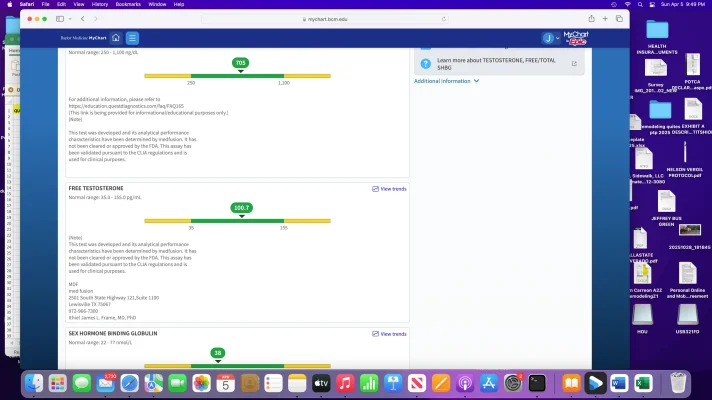
5 days post-injection you are hitting a robust TT 705 ng/dL but hard to tell where the most critical fraction sits which is free testosterone as I have no idea what testing method was used and you never posted the reference ranges.
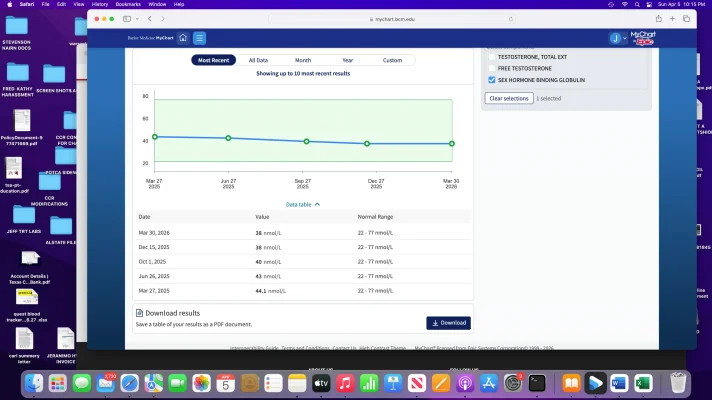
Do you have any idea where your SHBG sits?
Keep in mind even though you are hitting a robust TT 705 ng/dL 5 days post-injection your FT may not be that high if you have high SHBG.
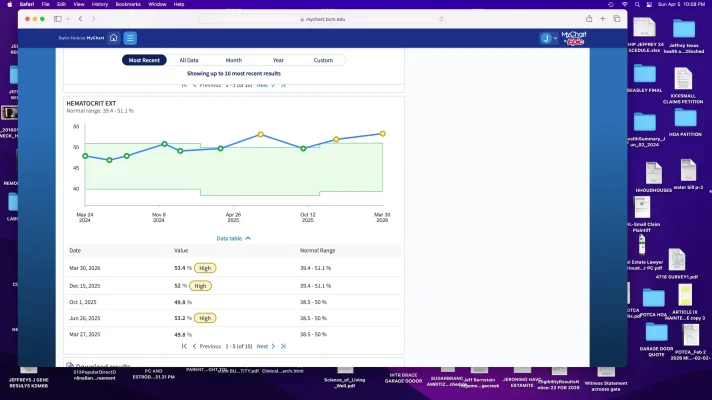
I do not agree with stopping the injections for a week as the main issue here most likely contributing to your
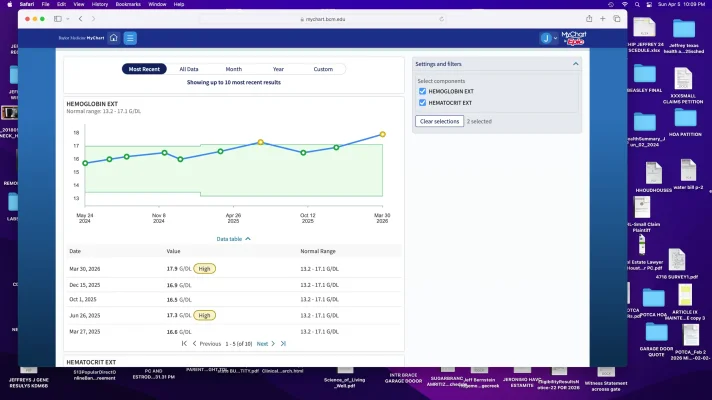
high hematocrit 53.4% which is still just shy of the cut-off 54% would be the obstructive sleep apnea.
Once you address the OSA which should be done ASAP it is pretty much a given your hematocrit will improve over time.
Please look over the threads posted below!
* Most current guidelines, including those from the American Urological Association and the Endocrine Society, flag hematocrit above 54% as a threshold requiring intervention. Some clinicians use 52% as a softer “watch and manage” threshold, particularly for men with additional cardiovascular risk factors.
How often should men on TRT check their hematocrit?
The standard monitoring schedule includes a baseline CBC before starting TRT, a recheck at 3 to 6 weeks, another at 3 months, and then at 6 and 12 months once stable. Any dose or formulation change resets the monitoring clock, requiring a recheck 4 to 6 weeks later. Men with risk factors for elevated hematocrit (sleep apnea, smoking, COPD, or a history of clotting) should check more frequently: every 3 months until the trend is stable.
* The monitoring schedule, the intervention ladder, and the attention...
Look over my replies in this thread too!
One year in. Just had my 6month check in.
Peak Total T 1144, (injected 12 hours before test)
SHBG 19
Hematocrit 53
Cypionate: 120mg divided into twice weekly injections.
Any reason to back off to 100, given the low SHBG and hematocrit levels?
Dr wasn’t concerned and mentioned it could be dehydration or because I injected so recently, but that we’ll keep an eye on it.